

What Is A Solar Eclipse?
An eclipse is a natural phenomenon when the Moon moves between the Sun and Earth, blocking the Sun's rays and casting a shadow on Earth. Find out why they happen, and how to watch them safely.
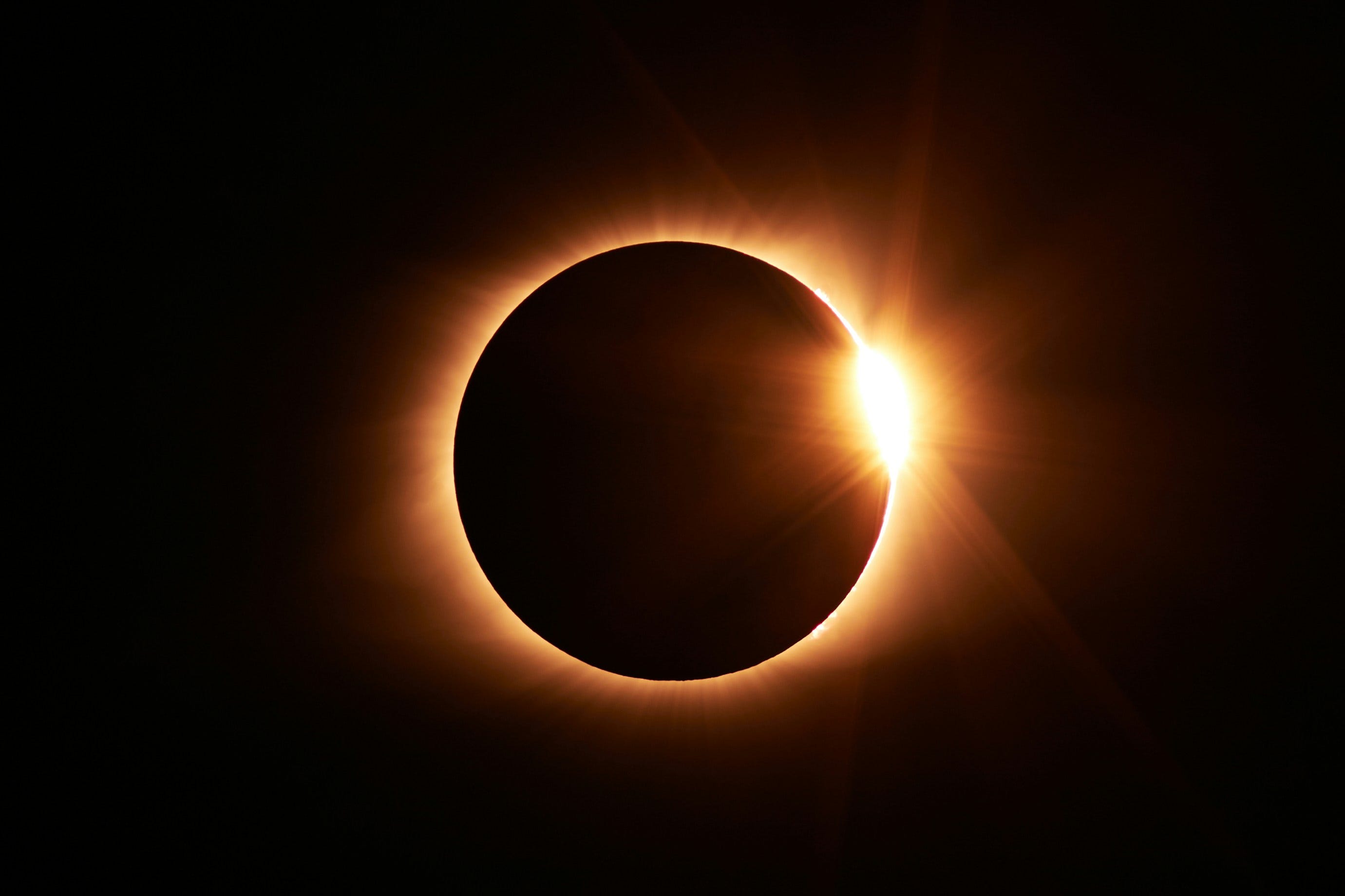
Every day, the Sun sets below the horizon and turns our world dark once again. But what if the world went dark in the middle of the day for a couple of minutes? This is the gist of what happens during a solar eclipse when the Moon moves in just the right way between us here on Earth and the Sun, blocking out sunlight.
The next solar eclipse is set to happen on August 12th. Totality is viewable from Greenland, Iceland, Northern Russia, the Atlantic Ocean, Spain and some parts of Portugal. So it feels like the perfect time to dive into this topic and figure out together what a solar eclipse is.
CAUTION! Please don’t look directly at the sun, even when it goes dark during a solar eclipse. If you would like to view this event, it’s best to get the correct eyewear to do so safely.
The Short Answer
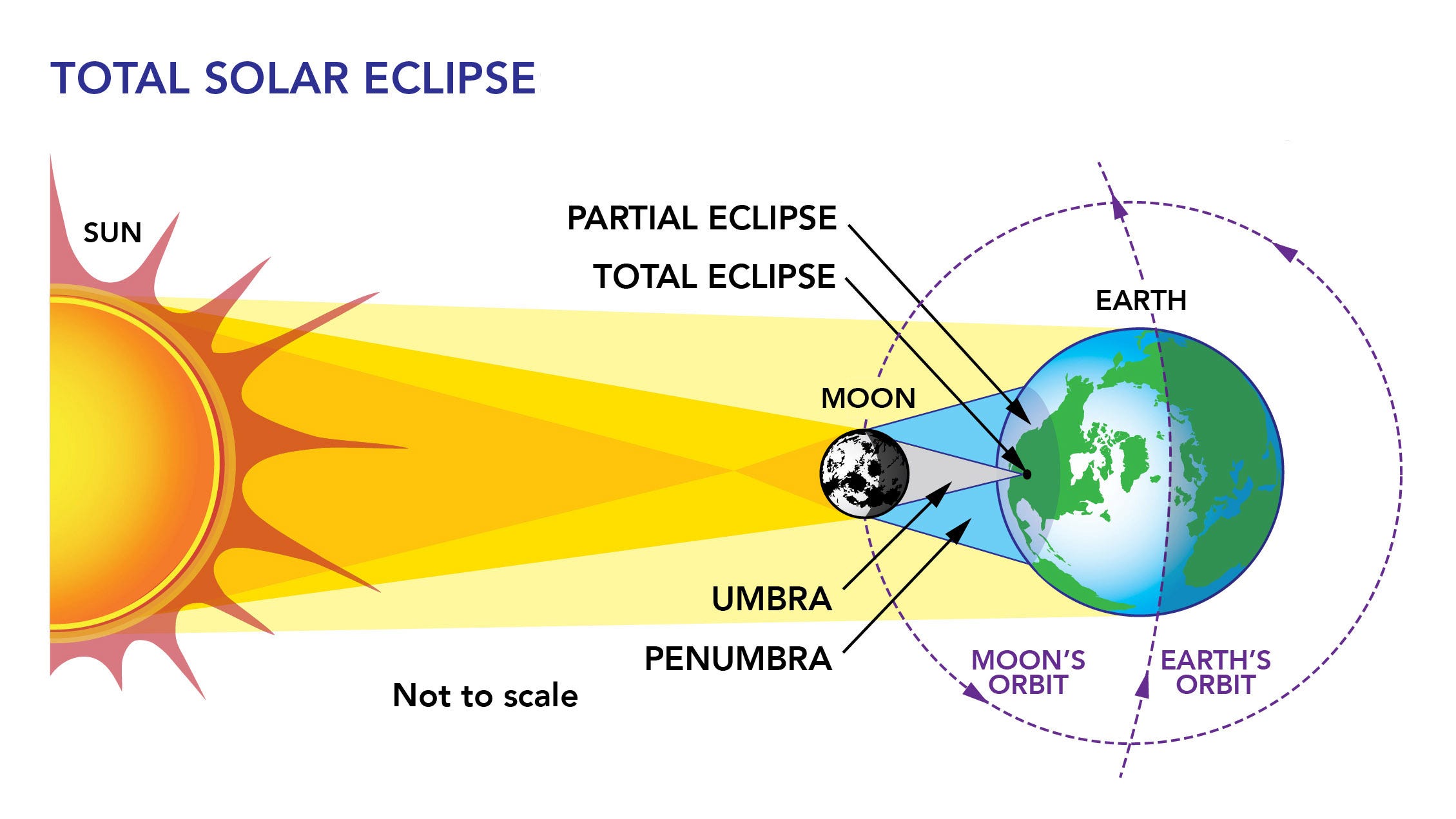
In short, an eclipse happens when a planet or a moon gets in the way of the Sun’s light. In the case of a solar eclipse, this is when the Moon blocks out the sunlight, casting a shadow on the Earth during the day. The dark central portion of this shadow that causes the total solar eclipse is called the umbra, and the surrounding lighter outer parts of the shadow, known as the penumbra, create a partial solar eclipse.
But you’re here to learn a bit more than that, so let’s jump into the long answer.
Why does a solar eclipse happen?
So far we’ve learnt that a solar eclipse happens when the Moon gets in the way of sunlight. But what makes a solar eclipse so special that we don’t get eclipses happening more often? It all comes down to the remarkable coincidence of geometry and ratio.
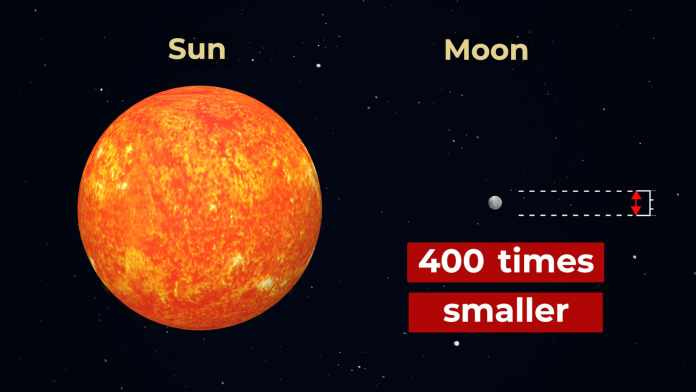
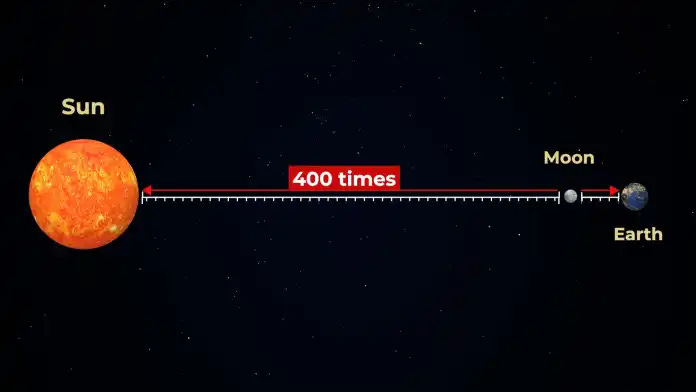
The Sun is about 400 times bigger than the Moon; however, it is also 400 times farther away. This is what makes the Sun and Moon appear almost exactly the same size in our sky. As a result, when the Moon lines up precisely in front of the Sun, it blocks out the entire solar disc, leaving the Earth in shadow and giving us a glimpse at the Sun’s outer atmosphere (only during totality).
We can’t normally see the corona — the Sun’s outer atmosphere — because the Sun’s surface below it is much brighter. But during a total solar eclipse, the corona emerges, offering unique opportunities to study it.
But that still leaves the question of why we don’t witness a total eclipse during every single new moon. The answer is the Moon’s orbit. We would indeed witness a total solar eclipse every new moon if the Moon orbited the Earth in a perfect circle, on the same plane as Earth’s orbit around the Sun. However, neither of those things is true. Instead, orbits are ellipses, not circles, so distances vary. The Moon’s distance from Earth swings by about 5.9% from its average, and Earth’s distance from the Sun by about 0.85%. Since apparent size depends on distance, the Moon doesn’t always look big enough to fully cover the Sun. Only when it’s closer than average can it appear large enough for totality.
You can test out apparent size using just your thumb. Pick something to look at in the distance and hold your thumb out in front of one eye. Now walk towards it or away from it and see how it becomes fully hidden behind your thumb. See how the size changes with distance?
Just as important, though, is the Moon’s tilt. The Moon’s orbit is tilted about 5 degrees relative to Earth’s orbit around the Sun. Most months, that tilt means the Moon passes above or below the Sun in the sky rather than directly across it, so its shadow simply misses Earth. An eclipse can only occur near the two points where the Moon’s tilted path crosses Earth’s orbital plane, and only when the Sun sits within about 15 to 18 degrees of one of them. This window opens twice a year, in eclipse seasons that last roughly 35 days and occur about six months apart.
Put all that together, and it’s easy to see why any single spot on Earth experiences a total solar eclipse only about once every 375 years on average. It takes the Moon being at just the right distance, the alignment being tight enough, and your location happening to lie in the narrow path of that shadow, all at the same time.
In some ancient and modern cultures, solar eclipses were linked to supernatural causes or regarded as bad omens.
Types of Solar Eclipses
As cool as solar eclipses are, there are a couple of different types. Total eclipses are seen by those in the path of totality when the Moon covers 100% of the Sun; however, those outside of this path see a partial eclipse at a range of totality (where we are in the UK, we’ll see ~91% totality on Wednesday). Aside from these two, there are also annular eclipses, hybrid eclipses, and central eclipses. Check out the graphics below to learn more about them.


Phases of Solar Eclipses
Though totality lasts between a few seconds and ~7 seconds, the full eclipse event, from first contact to last, often lasts around 2 to 4 hours.
First contact (partial eclipse begins) is the starting point of an eclipse event. When the Moon’s edge meets the edge of the Sun, the Moon’s shadow starts becoming visible over the Sun’s disc.
Second contact (total eclipse begins) is when almost the entire Sun’s disc is covered. This phase is also characterised by the diamond ring effect.
Totality is when the Moon obscures the entire disc of the Sun, and only the solar corona is visible.
Third contact (total eclipse ends) is when the first bright light becomes visible, and the Moon’s shadow is moving away from the observer. Again, the diamond ring may be observed.
Fourth contact (partial eclipse ends) is the end of the eclipse. The Moon stops overlapping the Sun’s disc, and everything goes back to usual.
How to watch safely
As we mentioned at the beginning, please DO NOT look at the Sun even during a total solar eclipse!
However, if you do want to watch safely, I’ve gathered some resources that I urge you to check out to make sure you stay safe during this coming and any future solar eclipses.
If you enjoy my work and want to help keep these stories free for everyone, I’d appreciate your support at any level that feels comfortable:
💡 £1/month or £10/year - A small boost with a big impact.
🌱 £2/month or £20/year - Helping support free science content.
🔬 £3/month or £30/year - Investing in science communication.
🌍 £4/month or £40/year - Expanding science for everyone.
🚀 £5/month or £50/year - Powering independent science writing.
Everything I create will still stay free for everyone to read. Paid subscriptions simply help support the time, research, and work that goes into making science easier to understand and accessible to more people.
And honestly, just reading, sharing, or recommending Explain It All already means a lot.
Микорасон 10 08