

Why Do We Get Brain Freeze?
Ice-cream can sometimes trigger a short lasting headache, but what links the cold sensation to pain?

With the warm weather on its way here in the UK, it’s the time of year when ice-creams and cold drinks are the go-to food and drinks of choice. And along with it comes the rite of summer, the brain freeze. How can something that tastes so good hurt so badly? Well, in this week’s article we’re going to look at what brain freeze actually is, and why cold foods and drinks cause it.
The Short Answer
In short, a brain freeze is the brain’s way of interpreting messages from the trigeminal nerve — a nerve that covers your face — when the roof of your mouth experiences a rapid temperature change.
But this only covers the surface of what a brain freeze is, so let’s dive deeper to find out exactly why we get them.
Why Do We Get Brain Freeze?
Let’s first look into what triggers a brain freeze — or, if we want to call it by its scientific name, sphenopalatine ganglioneuralgia.
Brain freeze is triggered by something very cold, such as ice cream, cold water, ice cubes, or even freezing air, touching the roof of your mouth. The brain doesn’t really like this rapid change of temperature, so it attempts to warm it up. Blood vessels in the sinuses — where there are a lot! — quickly constrict and then expand again to let extra blood into the area for warmth. This sudden change in blood vessel size triggers a brain freeze.
The signal from this trigger is then sent through the trigeminal nerve, a nerve that sits in the face, and the brain then interprets it as pain coming from the head instead of the roof. Another word for this is ‘referred pain’, which is pain that is perceived at a location other than the site of the painful stimulus. A fun fact to add to that is that the brain can’t actually feel pain.
A bit more about the trigeminal nerve…
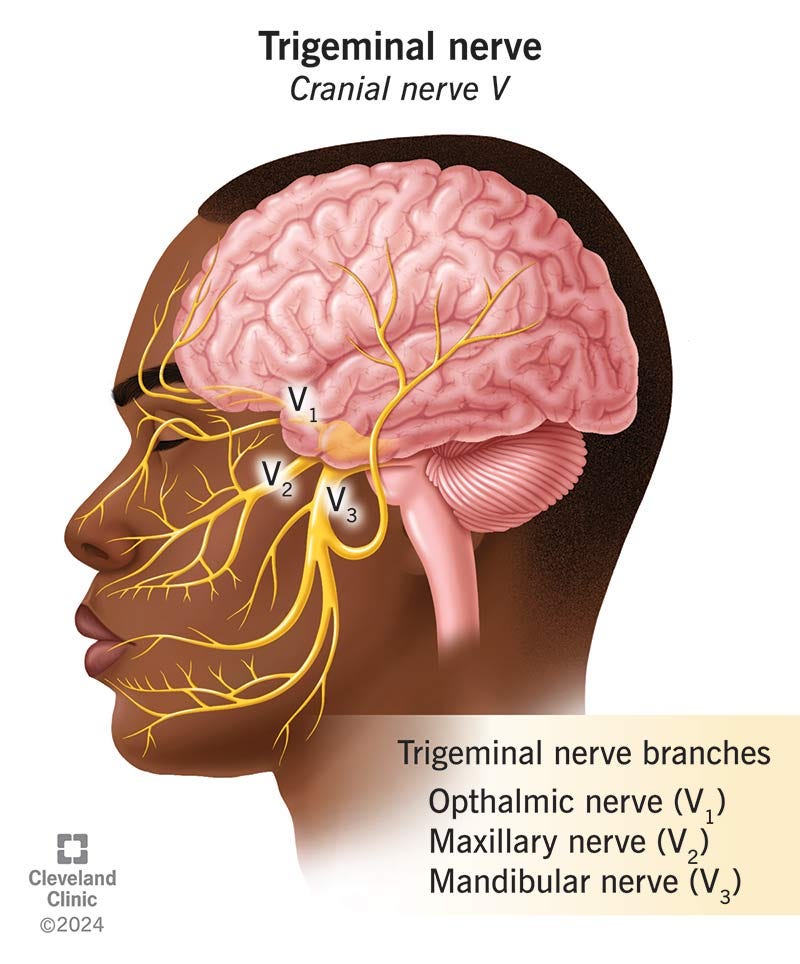
This nerve helps the face recognise pain and touch sensations from both cold and hot things. Also known as the fifth cranial nerve (CN V), it is a large three-part nerve in your head that sends signals from your brain to parts of your face and vice versa. So it is the link between the mouth’s roof, brain, sinuses, and forehead.
The Takeaway
To conclude, though a brain freeze has a rapid onset, it is not serious and goes away in a few seconds or minutes as the body works to regulate its temperature and the brain tries to keep up.
So the next time your brain freezes up while you’re having a nice cold drink on a hot summer’s day, know that the nerves in your face are working just as they should, even if you feel like they are being sensitive to a great-tasting drink.
Thanks for stopping by — hit reply and tell me what you’re curious about next!
If you enjoy my work and want to help keep these stories free for everyone, I’d appreciate your support at any level that feels comfortable:
💡 £1/month or £10/year - A small boost with a big impact.
🌱 £2/month or £20/year - Helping support free science content.
🔬 £3/month or £30/year - Investing in science communication.
🌍 £4/month or £40/year - Expanding science for everyone.
🚀 £5/month or £50/year - Powering independent science writing.
Everything I create will still stay free for everyone to read. Paid subscriptions simply help support the time, research, and work that go into making science easier to understand and accessible to more people.
And honestly, just reading, sharing, or recommending Explain It All already means a lot.
Now only if another brain freeze, writers' block, was so easy to explain!
Great information! 🧠🧊💯
Thanks for sharing this fun and informative writing with us! 🙏